Integrated HMI, PLC, and I/O: How to Optimize Space and Costs in Electrical Panels
by MectIn recent years, the push towardIndustry 4.0/5.0 has highlighted the need to reduce the footprint, simplify wiring, and speed up the commissioning of automation systems. An effective solution isthe monoblock architecture offered by Mect in the CM4 line (TPX4150, TP4070, TPX4190) and the TPAC series.
This article uses concrete data to analyze how integrating HMIs, PLCs, and I/O into a single device can lead to significant savings in terms of hardware, assembly time, and testing, while also improving the reliability and maintainability of installations.
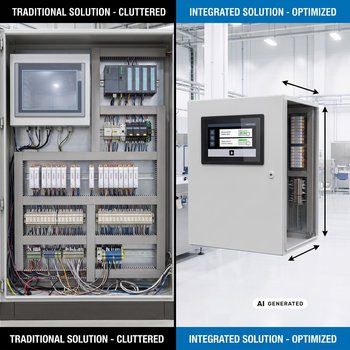
The Traditional Problem with Electrical Panels
| Elemento | Configurazione tipica | Conseguenze |
|---|---|---|
| HMI | Pannello separato (display + alimentazione) | Spazio aggiuntivo, necessità di cavi di alimentazione e segnale |
| PLC | Scatola a parte, spesso con rack DIN | Cablaggio di segnale tra PLC e HMI, più moduli I/O esterni |
| I/O | Moduli discreti (digitali/analogici) | Molti cavi di campo, necessità di bus di comunicazione (Modbus, CAN, ecc.) |
| Cablaggio | Centinaia di fili tra i tre blocchi | Aumento dei tempi di assemblaggio, rischio di errori di connessione, maggiore manutenzione |
On average, a medium-power unit (≈ 2 kW) requires 3–5 kW of internal space, 10–15 m of signal cable, and 2–3 days of work for assembly and testing.
The CM4 and TPAC monoblock architecture: What’s new?
A single “all-in-one” device
- Capacitive touchscreen HMI (7", 15", or 19") with Full HD resolution.
- IEC 61131-3-certified soft PLC (ST, FBD, SFC, LD, IL) integrated into the same chassis.
- Digital inputs/outputs (4 PNP onTPX4150/TPX4190, 4 PNP on TP4070) and expandability via modules MPNE1001, MPNC020, MPNC030, MPNC035.
Ready-to-Use Communication
- Modbus RTU/TCP, MQTT, TCPRTU over Ethernet and RS-485.
- Wi-Fi support and a 4G dongle for remote connections (OpenVPN, VNC, SFTP).
Unique Software – MECT SUITE CM series
- Qt Creator for HMI graphics and variable definition.
- ATCMControl for PLC programming in all 5 IEC 61131-3 languages, with PID and self-tuning libraries.
- Integrated debugging (PLC + HMI) and management of recipes, alarms, logging, and trends.
Analysis of the Concrete Benefits
| Vantaggio | Come si ottiene | Impatto quantitativo (esempi tipici) |
|---|---|---|
| Riduzione ingombro | Un solo chassis (es. 270 × 420 × 70 mm per TPX4150) sostituisce HMI + PLC + moduli I/O | -30 % di spazio interno risparmiato rispetto a configurazioni tradizionali |
| Meno cablaggio | I/O integrati + bus Modbus interno | -12 m di cavo di segnale (media) eliminati; riduzione del 40 % dei punti di connessione |
| Costi hardware | Eliminazione di PLC separati, rack DIN, alimentatori aggiuntivi | -25 % di costo di componenti |
| Tempi di montaggio | Installazione “plug‑and‑play” + configurazione software unica | -1,5 giorni di assemblaggio (vs. 3 giorni) |
| Tempi di collaudo | Debugger integrato, variabili ritentive, test di rete automatici | -30 % di tempo di collaudo (da 8 h a 5‑6 h) |
| Affidabilità | Meno punti di guasto (cavi, connettori) + case metallico IP65 | -15 % di riduzione dei guasti in campo (studi Mect 2023) |
Practical Example - 500-piece packaging line
- Traditional configuration: 1 HMI + 1 PLC + 2 I/O modules → 3 kW of space, 14 m of cable, 3 days of installation.
- TPX4150 monoblock solution (15″) + MPNC020 module (16 digital I/Os) → 2.1 kW of space, 5 m of cable, 1.5 days of installation.
- Total savings: ≈ 30% in space, ≈ 35% in hardware costs, ≈ 50% in time.
How This Translates into Value for the Customer
- Lower Capex - The initial investment is lower because fewer components and less wiring are purchased.
- Lower Opex —Less maintenance time, fewer wiring errors, and higher system availability.
- Time to Market - The development time for the interface (Qt Creator) and the control logic (ATCMControl) has been reduced by 30–40%, enabling new products to be launched more quickly.
- Scalability - Thanks to the expansion modules (MPNE1001, MPNC030, etc.), you can add new sensors or actuators without modifying the main control panel.
- Industry 4.0/5.0 Compliance — MQTT connectivity, logging to MySQL/SQLite databases, remote access via VPN, and cloud support make this solution “future-ready.”
5. Step-by-Step Implementation
| Fase | Attività | Strumento Mect |
|---|---|---|
| 1. Progettazione | Definizione dei requisiti di I/O, dimensionamento HMI, scelta dei protocolli | MECT SUITE CM (schemi di progetto, librerie I/O) |
| 2. Configurazione hardware | Installazione del pannello (TPX4150/TPX4070/TPX4190) e dei moduli di espansione | Moduli MPNE/MPNC con morsettiera estraibile |
| 3. Programmazione PLC | Codifica logica in IEC 61131‑3, importazione librerie PID, self‑tuning | ATCMControl (debugger integrato) |
| 4. Realizzazione HMI | Creazione schermate, trend, ricette, allarmi | Qt Creator (drag‑and‑drop, widget pre‑definiti) |
| 5. Test di comunicazione | Verifica Modbus, MQTT, VNC, OpenVPN | MECT SUITE (monitor di rete, logger) | MECT SUITE (monitor di rete, logger) |
| 6. Collaudo finale | Simulazione ciclo di lavoro, verifica variabili ritentive | Tool di collaudo integrato (report automatici) |
| 7. Messa in servizio | Deploy su campo, training operatore, documentazione | Manuali TPX4150/TPX4070/TPX4190 |
Conclusions
The adoption of monoblock operator panels from the CM4 line (TPX4150 – 15″, TP4070 – 7″, TPX4190 – 19″) and the ability to expand functionality with the MPNE and MPNC modules represent a breakthrough for those looking to optimize their control panels.
- Space: up to a 30 % reduction.
- Hardware costs: a 20–25 % decrease.
- Assembly and testing time: 40–50% reduction.
The result is a more compact, more reliable system that is ready to integrate with IIoT platforms, without sacrificing flexibility or programming power.
If you want to turn your next project into a success story, contact Mect for technical advice and a customized quote.
Optimize your system today, and prepare for the future.
Mect – Integrated solutions for industrial automation.
Request a Quote | Contact Us | TPX4150, TP4070, TPX4190